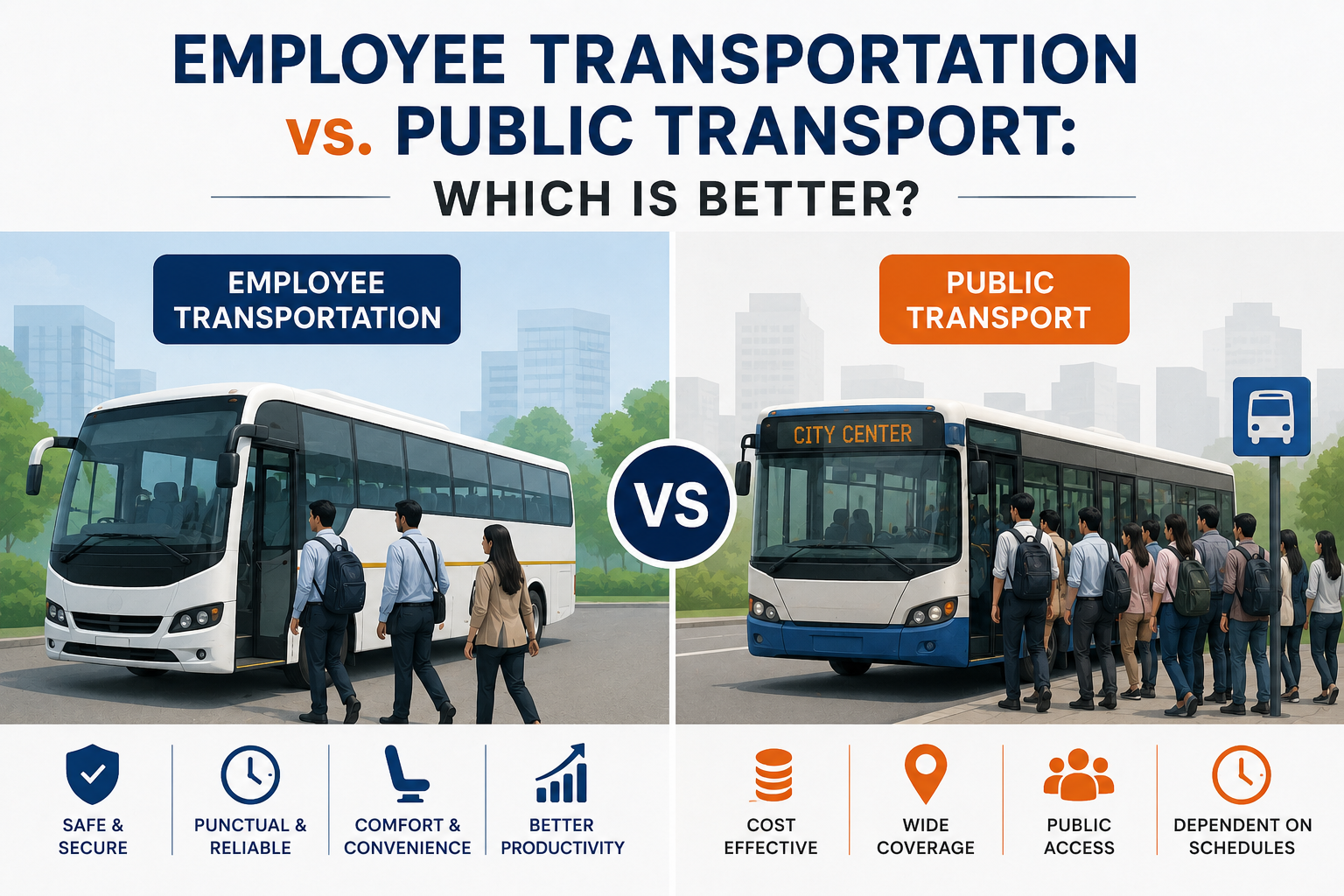
Choosing the right way to get employees to and from work has become an important business decision. Long commutes, traffic congestion, unpredictable public transport, and growing expectations around workplace safety can all affect employee experience and productivity. This is why corporate employee transportation is becoming an increasingly practical option for businesses that want to make commuting easier and more reliable.
But is company-provided transportation actually better than public transport? The answer depends on factors such as cost, employee schedules, workplace location, safety requirements, and the type of workforce a company has.
Let’s compare both options and see which approach makes the most sense for modern businesses.
Why Does Employee Transportation Matter for Businesses?
A daily commute can have a direct impact on how employees begin and end their working day. Spending long hours in traffic or standing in an overcrowded bus or train can contribute to fatigue and frustration.
For businesses operating in busy metropolitan areas, commuting can also create punctuality problems. Delays, traffic jams, missed connections, and limited public transport options can result in employees arriving late or feeling exhausted before their workday even begins.
A well-planned employee transportation program can address many of these issues by providing employees with a more predictable journey between convenient pickup points and the workplace.
What Are the Advantages of Corporate Transportation?
Can Corporate Shuttles Improve Productivity and Punctuality?
One of the biggest advantages of a corporate shuttle is a more direct commute. Instead of employees planning multiple connections between buses, trains, or other forms of transit, company transportation can be organized around workplace locations and employee requirements.
This can make arrival times more predictable and reduce time wasted during transfers.
Some corporate transportation services can also provide amenities such as Wi-Fi, allowing employees to use their commuting time productively when appropriate. Even when employees simply use the journey to relax, arriving at work less stressed can contribute to a better start to the day.
Is Corporate Transportation Safer?
Safety is another major consideration, particularly for employees travelling early in the morning or late at night.
Professional corporate transportation programs can incorporate features such as GPS tracking, verified drivers, trip monitoring, and defined pickup and drop-off procedures. Businesses can also create specific transportation policies for employees working night shifts.
For organizations with employees who finish work late, dedicated transportation can provide an additional layer of security compared with waiting for or changing between public transport services at night.
What Are the Benefits of Public Transportation?
Is Public Transport More Affordable?
Public transportation can be an economical option, particularly when employees live close to established bus, metro, or railway networks.
From an employer's perspective, supporting public transport may also eliminate the need to operate a dedicated fleet. Companies do not necessarily have to manage vehicles, drivers, maintenance, fuel, scheduling, and other operational requirements associated with transportation.
For employees, individual public transit fares can also be relatively inexpensive, depending on the location and available services.
Does Public Transport Have Better Coverage?
Public transportation networks can cover large areas and provide access to established transit hubs. This makes them useful for employees who live in different parts of a city.
However, broad coverage does not always mean a convenient door-to-door commute. Employees may still need to walk significant distances, change buses or trains, or arrange separate transportation for the beginning or end of their journey.
What Are the Challenges of Public Transportation for Employees?
Reliability can become a major issue when employees depend entirely on public transportation.
Bus and train delays can affect arrival times, while service interruptions can create unexpected commuting problems. During peak hours, overcrowding can also make the journey uncomfortable and stressful.
For employees travelling long distances, several transfers can add considerable time to the daily commute. Over weeks and months, this can have a noticeable effect on employee satisfaction.
This does not mean public transportation is a poor choice. Rather, it shows why businesses should consider the complete commuting experience instead of looking only at the price of an individual trip.
How Can Companies Support Hybrid Employees?
Hybrid working has changed employee transportation requirements. A company may not need to transport every employee every day when some employees only come into the office two or three days a week.
Instead of operating fixed routes regardless of demand, businesses can use scheduling and route-optimization technology to adjust transportation according to office attendance.
This approach can help companies avoid running underutilized vehicles while still providing transportation when employees actually need it.
What Is First-Mile and Last-Mile Connectivity?
First-mile and last-mile connectivity describes the beginning and end portions of an employee's commute.
For example, an employee may be able to reach a major railway or metro station easily but have difficulty travelling from home to that station. Similarly, an employee may reach a transit hub near the office but still need another mode of transportation to complete the journey.
Corporate shuttles can help bridge these gaps.
Rather than replacing public transportation entirely, companies can use targeted employee transportation routes to connect employees with major transit hubs. This creates a hybrid mobility model that combines the strengths of both systems.
Are There Financial Benefits to Commuter Programs?
Transportation costs should be evaluated from both the employee and employer perspective.
Depending on the country and applicable regulations, commuter programs may provide tax-related benefits, such as eligible pre-tax transportation benefits or transit programs. Businesses should confirm the applicable rules with a qualified tax professional because these benefits vary by location.
More importantly, companies should consider the overall business impact of transportation. The true cost is not simply the price of a vehicle or transit pass. It can also include lost working time, employee turnover, absenteeism, administrative effort, and employee satisfaction.
How Should Businesses Calculate Transportation ROI?
A useful way to evaluate corporate employee transportation is to calculate cost per occupied seat rather than simply looking at the total cost of operating a vehicle.
Businesses can consider:
Number of employees using the service
Average vehicle occupancy
Number of operating days
Route distance and travel time
Driver and vehicle costs
Fuel and maintenance expenses
Technology and monitoring costs
Employee utilization and satisfaction
This provides a more realistic picture of whether a transportation program is delivering value.
Is a Hybrid Transportation Model Better?
For many businesses, the choice does not have to be either corporate transportation or public transportation.
A hybrid model can combine public transit subsidies with targeted corporate shuttle routes. Employees who have convenient access to buses, trains, or metro services can continue using them, while employees facing difficult first-mile or last-mile journeys can use company transportation.
This can be especially useful for hybrid offices, large campuses, businesses operating multiple shifts, and organizations with employees travelling outside normal public transport hours.
So, Which Is Better: Employee Transportation or Public Transport?
There is no single answer for every company.
Public transportation can be a cost-effective solution when employees live close to reliable transit networks and have convenient connections to the workplace.
Corporate employee transportation, on the other hand, can provide greater control over routes, schedules, safety procedures, and employee experience. It can be particularly valuable when employees face long commutes, multiple transfers, unreliable services, or late-night travel requirements.
For many modern businesses, the strongest solution may be a combination of both. By understanding employee travel patterns and using data to plan routes, companies can build a transportation strategy that balances convenience, safety, utilization, and cost.
Conclusion
Choosing between public transport and corporate employee transportation depends on the needs of the workforce, workplace location, budget, and commuting patterns. Public transport can be an affordable choice for employees with convenient and reliable connections, while corporate transportation offers greater flexibility, safety, comfort, and control over routes and schedules.
For many businesses, a combination of both can be the most effective approach. By using corporate shuttles for key routes, first-mile and last-mile connectivity, and late-night shifts while supporting public transportation where practical, companies can create a more reliable and employee-friendly commuting experience.
Ultimately, the right transportation strategy is not just about reducing travel costs. It is about helping employees reach work safely, comfortably, and on time while creating measurable value for the business.
Acciva Travels offers professionally managed corporate employee transportation solutions that help businesses provide safe, reliable, and convenient daily commuting for their workforce. With services covering route planning, fleet coordination, employee pickup and drop, and technology-enabled transportation management, Acciva Travels helps organizations streamline employee mobility while improving operational efficiency.
Frequently Asked Questions
What is the primary difference between a corporate shuttle and public transport?
Corporate shuttles are designed around an organization's employees, routes, and working hours, offering a more direct and controlled commuting experience. Public transport serves the broader population and is generally more economical, but employees may experience transfers, delays, and overcrowding.
Is company-provided transportation cost-effective for hybrid offices?
Yes. Businesses can use attendance data, route optimization, and smart scheduling to operate transportation only when there is sufficient employee demand. This can make company transportation more practical for employees who work from the office only a few days each week.
What does first-mile and last-mile connectivity mean?
It refers to the beginning and final portions of a commute. For example, an employee may need transportation from home to a metro station or from a railway station to the office. Corporate shuttles can help connect these gaps.
How can businesses benefit from commuter programs?
Depending on local regulations, eligible commuter programs may provide tax advantages or other financial benefits. Companies should check current rules in their jurisdiction before designing such a program.
Which transportation option is safer for late-night shifts?
Dedicated corporate transportation can offer additional safety measures such as GPS tracking, verified drivers, trip monitoring, and emergency procedures. These features can make it a strong option for employees travelling during late hours, although actual safety depends on how the service is designed and operated.