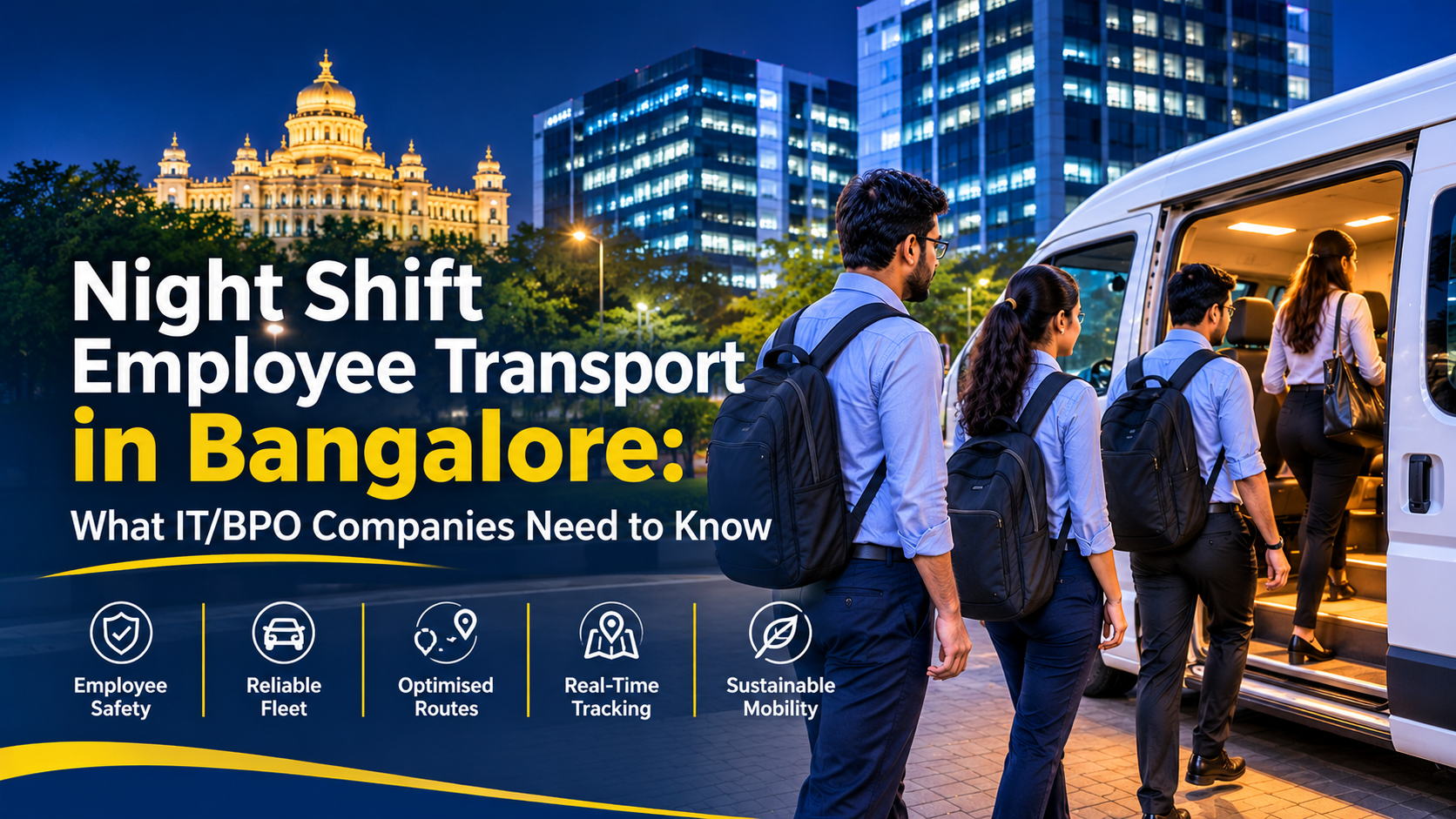
Night Shift Employee Transport in Bangalore is an important operational requirement for IT companies, BPO organisations and businesses that operate beyond regular office hours. Providing reliable transportation for employees working late evenings, overnight shifts and early mornings requires more than arranging individual cabs. Companies need a structured mobility system that prioritises employee safety, manages travel expenses, coordinates drivers and ensures smooth daily operations.
For HR managers and corporate travel teams, professionally managed employee transportation services offer a practical way to handle these responsibilities. With GPS tracking, real-time vehicle monitoring, route optimisation and dedicated fleet management, businesses can create a safer and more organised employee commuting experience while maintaining operational efficiency.
Why Night Shift Transportation Requires a Structured Approach
Bangalore's IT and BPO sector operates across multiple shifts to support clients in different time zones. Employees may start work late in the evening, finish after midnight or report to offices during early morning hours.
These schedules create transportation challenges that standard cab bookings may not always address.
Companies must consider:
Employee safety: Ensuring employees reach their destinations safely, particularly during late-night and early-morning journeys.
Shift coordination: Matching vehicle availability with changing employee schedules.
Driver accountability: Assigning trained and professional chauffeurs who understand corporate transportation requirements.
Route planning: Organising pickups and drop-offs to minimise unnecessary travel.
Operational continuity: Ensuring transportation remains available even when shifts change or employees work overtime.
A planned transportation system helps businesses manage these requirements without placing unnecessary administrative responsibilities on HR and facility management teams.
Essential Elements of Safe Night Shift Employee Transportation
Employee safety should be a central part of every corporate mobility programme. Organisations need clear transportation procedures that address potential risks throughout the journey.
1. Employee Safety and Journey Monitoring
Companies should select transportation partners that provide vehicle tracking, journey visibility and appropriate escalation procedures.
Important safety measures include:
GPS-enabled vehicles for journey tracking.
Verified drivers with appropriate documentation.
Emergency contact and escalation procedures.
Clear employee pickup and drop-off records.
Reliable communication between drivers and transport coordinators.
Appropriate late-night drop-off and employee handover procedures.
For example, when an employee's scheduled drop-off is delayed, the transport coordination team should be able to identify the vehicle's location and communicate with the driver.
2. Professional Chauffeurs and Driver Management
Drivers directly influence the quality and safety of corporate transportation. Businesses should look for chauffeurs who demonstrate punctuality, professional behaviour, route familiarity and responsible driving practices.
Regular driver verification, document checks, training and performance monitoring help maintain consistent service standards.
A professional chauffeur should also understand corporate travel protocols, employee communication requirements and the importance of following approved pickup and drop-off instructions.
3. Fleet Availability and Vehicle Maintenance
Vehicle availability is particularly important for businesses operating multiple shifts. Unexpected breakdowns or last-minute vehicle shortages can affect employee attendance and business operations.
A professionally managed fleet should include:
Regular vehicle inspections and servicing.
Clean and comfortable vehicles.
Appropriate vehicle selection based on passenger requirements.
Backup arrangements for unexpected breakdowns.
Driver and vehicle allocation based on shift schedules.
Businesses can explore Acciva Travels Fleet Management Services to understand how structured fleet operations support corporate mobility requirements.
How Employee Pickup Drop Route Optimization Improves Efficiency
Managing employee transportation across Bangalore can become complicated when employees live in different neighbourhoods and work at different office locations.
Without proper planning, companies may experience overlapping routes, unnecessary vehicle kilometres, delayed pickups and higher transportation expenses.
Employee pickup drop route optimization helps businesses organise journeys based on employee locations, shift timings, traffic conditions and vehicle capacity.
Practical Ways to Improve Route Planning
Group employees by location: Employees living in nearby areas can be assigned to suitable shared routes, depending on shift timings and vehicle capacity.
Consider Bangalore traffic patterns: Pickup schedules should account for congestion, road conditions and expected travel duration.
Use technology for route planning: Digital route planning systems can help transport coordinators identify efficient pickup sequences and suitable vehicle allocations.
Review routes regularly: Employee residential locations, shift schedules and office attendance patterns may change. Regular route reviews help maintain efficiency.
For example, a company transporting employees from Whitefield, Marathahalli and Electronic City can organise separate routes based on employee locations and reporting times rather than assigning vehicles without considering geographical requirements.
This approach supports better vehicle utilisation, more predictable travel schedules and improved expense management.
How AI, GPS Tracking and Data Analytics Improve Corporate Mobility
Technology is changing how organisations manage employee transportation. Instead of depending entirely on manual coordination, businesses can use digital systems to improve visibility and make informed operational decisions.
Artificial Intelligence for Smarter Transportation Planning
AI-powered systems can analyse employee locations, shift schedules, historical travel patterns and other operational inputs to support vehicle allocation and route planning.
Depending on the system's capabilities, AI can help identify scheduling conflicts, suggest alternative routes and support more efficient transportation planning.
GPS Tracking and Real-Time Monitoring
GPS technology provides visibility into vehicle locations and journey progress. Transport coordinators can use this information to monitor pickups, identify delays and communicate with drivers when necessary.
Real-time monitoring is particularly useful for night shifts because it helps organisations maintain better oversight of employee journeys.
Data Analytics for Better Decisions
Transportation data can help companies understand how their mobility operations perform.
Useful indicators include:
Vehicle utilisation rates.
Average pickup and drop-off times.
Route distance and travel duration.
Fuel consumption.
Trip cancellations and delays.
Monthly transportation expenditure.
Analysing these indicators helps travel managers identify operational inefficiencies and make improvements based on actual travel patterns.
Managing Corporate Transportation Expenses Without Compromising Safety
Transportation is a recurring operational expense for organisations with large employee teams. However, reducing expenses should not come at the expense of employee safety or service reliability.
Companies can improve cost management through better planning and resource allocation.
Some practical approaches include:
Combining suitable employee trips where schedules permit.
Selecting vehicles based on passenger requirements.
Avoiding unnecessary vehicle movements.
Reviewing route distances and travel patterns.
Monitoring fuel consumption and vehicle utilisation.
Evaluating monthly transportation costs against service requirements.
Businesses should also consider transparent billing structures, clearly defined service terms and reporting procedures when selecting a transportation partner.
Electric Vehicles and Sustainable Corporate Transportation
Sustainability is becoming an important consideration in corporate mobility planning. Electric vehicles (EVs) provide an alternative to conventional fuel-powered vehicles and can help organisations reduce tailpipe emissions.
For companies considering EV-based employee transportation, several factors require attention.
Charging infrastructure: Businesses should evaluate charging availability near offices, residential areas and vehicle parking facilities.
Daily travel requirements: Vehicle range must be suitable for planned pickup and drop-off routes.
Fleet availability: Transportation partners should assess whether suitable EV models are available for the required passenger capacity and schedules.
Operational planning: Charging schedules, vehicle utilisation and backup arrangements must be considered to avoid interruptions.
A gradual transition to suitable electric vehicles can support corporate sustainability objectives while maintaining employee transportation reliability.
Regular Cab Booking vs Professionally Managed Corporate Transportation
Regular cab booking and professionally managed corporate car rental serve different business requirements. Individual bookings may be suitable for occasional travel, whereas organisations operating multiple shifts often need a coordinated transportation system.
Comparison Factor | Regular Cab Booking | Managed Corporate Transportation |
Booking process | Individual or on-demand booking | Planned scheduling and vehicle allocation |
Driver management | Depends on the service provider | Structured driver verification and management |
Employee safety | Standard trip-level safety features | Organised safety procedures and journey monitoring |
Route planning | Usually handled per booking | Coordinated employee pickup and drop routes |
Fleet availability | Depends on immediate availability | Planned fleet allocation and backup arrangements |
Expense management | Individual trip-based payments | Consolidated billing and travel reporting options |
Shift coordination | Requires repeated bookings | Supports recurring and multiple-shift schedules |
Operational visibility | Primarily trip-based | Centralised coordination and monitoring options |
For organisations with regular night shift operations, managed corporate transportation provides a more structured approach to employee commuting.
Businesses looking for dedicated mobility arrangements can explore Acciva Travels Corporate Cab Services.
How to Choose the Right Corporate Mobility Partner in Bangalore
Selecting a transportation provider requires evaluating more than vehicle availability and quoted prices. Companies should assess whether the provider can support their operational requirements consistently.
Consider these factors before making a decision:
Safety procedures: Check driver verification, vehicle documentation, emergency response procedures and journey monitoring capabilities.
Fleet capacity: Ensure the provider can accommodate employee numbers, multiple shifts and changing schedules.
Technology support: Evaluate GPS tracking, digital reporting, communication systems and route planning capabilities.
Service flexibility: Confirm whether the provider can handle overtime, schedule changes and additional transportation requirements.
Billing transparency: Understand pricing structures, additional charges and reporting arrangements.
Maintenance standards: Check vehicle inspection, servicing and breakdown support procedures.
Operational communication: Ensure there is a clear contact point for employees, HR teams and transport coordinators.
A suitable corporate mobility partner should be able to adapt its transportation arrangements as employee numbers, business operations and commuting requirements evolve.
Corporate Employee Transportation Support from Acciva Travels
Managing employee transportation across Bangalore requires coordination, dependable vehicles and a clear understanding of corporate travel requirements.
Acciva Travels provides corporate transportation solutions designed to support businesses with employee commuting and business travel needs. Organisations can explore its Employee Transportation Services for structured employee mobility requirements.
Businesses can also consider its Fleet Management Services to understand fleet-related operational support.
Whether a company requires daily employee pickup and drop arrangements, scheduled corporate cab services or transportation support for different working shifts, selecting a suitable service model is essential for maintaining reliable operations.
Conclusion
Reliable night shift employee transportation helps IT and BPO companies improve employee safety, manage travel expenses and maintain operational efficiency. With professional chauffeurs, fleet management and route optimisation, businesses can create a better commuting experience.
Acciva Travels provides corporate mobility solutions to support employee transportation requirements. Contact Acciva Travels to explore suitable transportation solutions for your business.
Frequently Asked Questions
1. What is night shift employee transportation?
Night shift employee transportation is a corporate mobility arrangement that provides scheduled pickup and drop-off services for employees working during evening, overnight and early morning shifts. It typically involves planned routes, assigned vehicles, driver coordination and journey monitoring.
2. Why do IT and BPO companies need dedicated employee transportation services?
IT and BPO companies often operate around the clock to support international clients. Dedicated employee transportation helps coordinate multiple shifts, improve journey visibility, manage travel expenses and provide reliable commuting arrangements.
3. How does route optimization reduce corporate transportation expenses?
Route optimisation helps organise employee pickups and drop-offs based on geographical locations, shift timings and vehicle capacity. Better planning can reduce unnecessary travel distances, improve vehicle utilisation and support more efficient fuel management.
4. How does GPS tracking improve night shift employee safety?
GPS tracking allows transport coordinators to monitor vehicle locations and journey progress. It helps identify delays, improve communication with drivers and provide better visibility into employee transportation operations.
5. What should companies check before hiring a corporate transportation provider in Bangalore?
Companies should evaluate driver verification, vehicle maintenance, fleet availability, GPS tracking, route planning, emergency procedures, billing transparency and the provider's ability to manage multiple employee shifts.