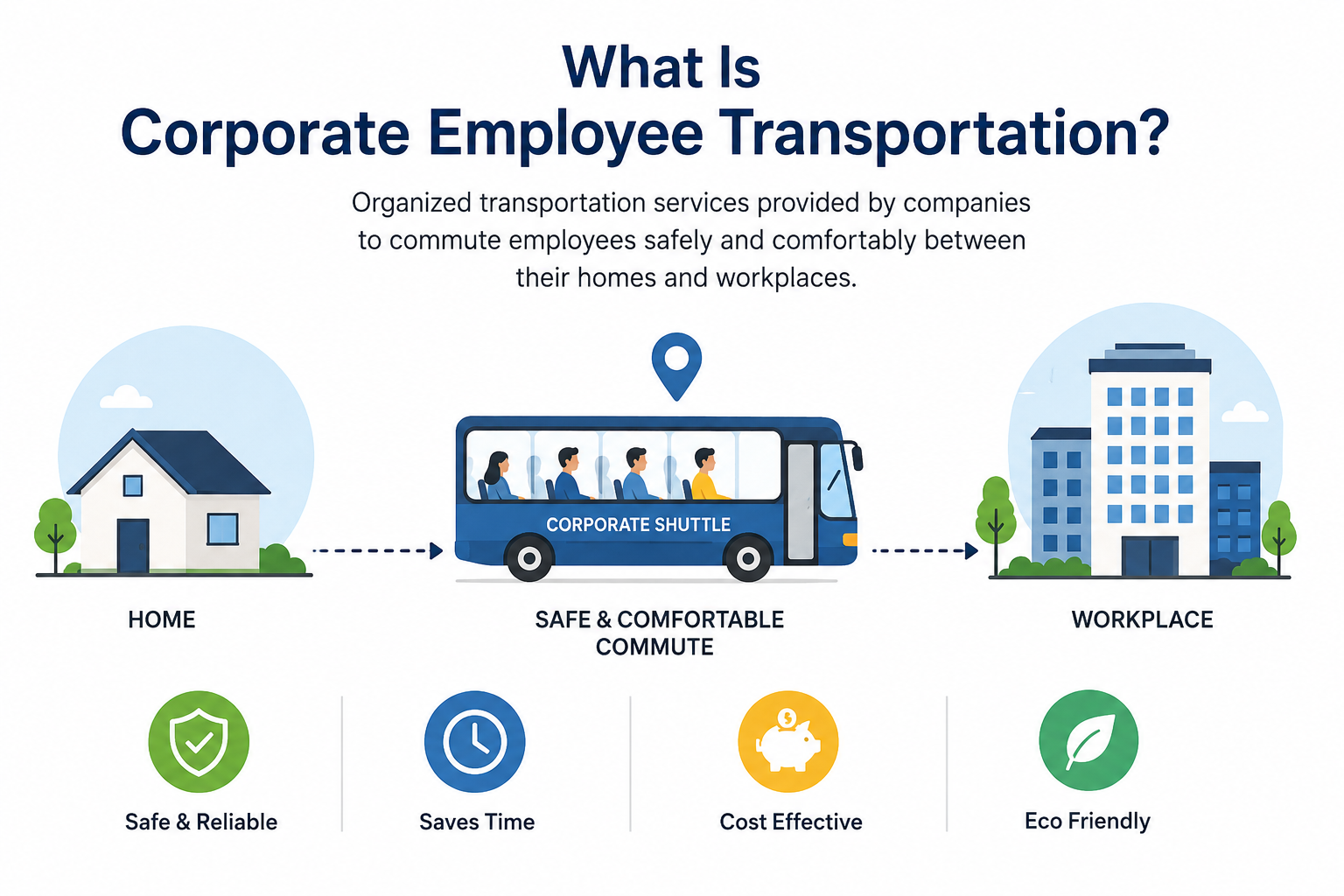
1. What Is Corporate Employee Transportation?
Corporate employee transportation is a structured mobility service that helps businesses transport employees between their homes, designated pickup points, and workplaces. Instead of relying entirely on individual travel arrangements, companies can use managed cabs, shuttles, buses, route-based services, and technology platforms to coordinate employee travel.
A well-designed employee transportation program is more than simply arranging vehicles. It combines route planning, scheduling, driver management, safety procedures, technology, compliance, reporting, and cost control. For organizations operating multiple shifts or supporting employees across different locations, a reliable transportation system can become an important part of workforce management.
Acciva Travels provides reliable and technology-enabled corporate employee transportation solutions designed to support businesses with safe, efficient, and well-managed employee mobility. With services focused on transportation management, route planning, safety, fleet coordination, and operational efficiency, Acciva Travels helps organizations create a smoother and more dependable commuting experience for their employees.
2. Why Has Employee Transportation Become a Corporate Strategy?
Does the daily commute affect employee satisfaction?
Yes. Long, unpredictable, or uncomfortable commutes can affect employee experience and productivity. When employees have reliable transportation options, they can spend less time worrying about traffic, parking, vehicle availability, and late-night travel.
For employers, transportation can also support punctuality and attendance. A predictable employee transportation service allows companies to coordinate travel around office hours and shift schedules rather than leaving every employee to manage their commute independently.
How does transportation support return-to-office strategies?
Return-to-office policies can create practical challenges when employees live across different areas. Providing organized corporate transportation can make office commuting more convenient while helping businesses manage changing attendance patterns.
The important point is flexibility. Hybrid employees may not travel to the office every day, so companies need transportation plans that can adapt to changing demand rather than paying for unused capacity.
3. What Are the Main Corporate Employee Transportation Models?
What are fixed home-to-office managed cabs?
Fixed-route or dedicated cabs operate according to predetermined schedules and employee pickup locations. They can work particularly well when employees follow consistent office or shift timings.
Dedicated corporate cabs can also provide greater administrative control because organizations can establish requirements for drivers, vehicles, reporting, safety, and service quality.
What are feeder shuttles and pooled buses?
A shuttle or pooled bus model groups employees who live within similar geographical clusters. Employees travel to common pickup points before continuing toward the workplace.
This approach can be useful when many employees live within the same residential areas. It can reduce the number of individual vehicle trips and make fleet utilization more efficient.
Is a hybrid transportation model possible?
Yes. Businesses can combine dedicated vehicles, pooled routes, shuttle services, and technology platforms according to employee demand.
A hybrid approach can be particularly useful for organizations with different office locations, shift patterns, or hybrid working schedules.
Why can individual fuel reimbursements become difficult to manage?
Fuel reimbursement may appear simple for a small workforce, but managing large numbers of individual claims can create administrative work. Companies must process receipts, verify journeys, review claims, and manage different travel patterns.
A managed employee transportation program can consolidate transportation operations, making it easier to monitor trips, costs, routes, and service performance.
4. How Do AI, IoT, and Telematics Improve Employee Transportation?
Can AI optimize employee transportation routes?
AI-powered route optimization can analyze factors such as employee locations, pickup points, vehicle capacity, schedules, and traffic conditions. The objective is to create efficient routes while reducing unnecessary vehicle movement and travel time.
Instead of relying entirely on static routes, organizations can use technology to respond to changing demand.
What does real-time telematics provide?
Telematics can provide information about vehicle location, trip progress, estimated arrival times, and other operational data. An administrative dashboard can give transport teams greater visibility into active journeys.
This visibility can help organizations identify delays, monitor service performance, and respond to transportation issues more quickly.
How do employee transportation apps help commuters?
Employee-facing applications can simplify everyday transportation tasks. Depending on the system, employees may be able to view bookings, receive pickup information, monitor estimated arrival times, and access emergency assistance.
Self-service tools can also reduce repetitive communication between employees and transport administrators.
How should employee location data be handled?
Employee transportation systems can process sensitive operational information such as addresses, pickup points, schedules, and journey details. Companies should therefore establish clear data-access rules, retention practices, security controls, and privacy procedures.
Where applicable, organizations should assess their responsibilities under relevant privacy regulations, including India's Digital Personal Data Protection framework and the GDPR for organizations processing data within its scope.
5. What Safety Measures Should Corporate Transportation Programs Include?
How should drivers and vehicles be verified?
A strong employee transport management program should establish clear requirements for driver verification and vehicle compliance. Organizations can verify driver identity and qualifications and maintain appropriate documentation for vehicles used in employee transportation.
Regular audits can help ensure that safety standards remain consistent rather than being checked only when a service begins.
What safety measures are important for night shifts?
Night-shift transportation requires additional planning. Useful measures can include GPS tracking, active trip monitoring, emergency or SOS mechanisms, verified drivers, defined pickup and drop-off procedures, and appropriate safeguards for employees travelling alone.
For female employees travelling during late hours, companies may also implement escort policies, safe-drop confirmation procedures, or other measures based on their workforce and local requirements.
How can businesses prepare for disruptions?
Transportation plans should account for events such as heavy monsoon conditions, road closures, vehicle breakdowns, traffic disruptions, and sudden operational changes.
Having backup vehicles, alternative routes, emergency communication procedures, and escalation contacts can help maintain continuity when normal transportation arrangements are disrupted.
6. How Should a Company Choose an Employee Transportation Provider?
What should be included in an SLA?
A service-level agreement should clearly define operational expectations. Depending on the organization's requirements, these may include punctuality, vehicle availability, driver standards, response times, cancellation procedures, safety requirements, reporting, and escalation mechanisms.
Clear performance indicators make it easier to evaluate whether the transportation provider is delivering the agreed service.
Why is consolidated billing important?
Managing multiple vehicles and daily trips can create a significant amount of administrative work. Consolidated billing and automated trip reconciliation can help transport teams compare planned and completed journeys, identify discrepancies, and maintain organized financial records.
Can an employee transportation provider scale with business growth?
Scalability is an important selection criterion. A company may need additional vehicles during hiring growth, new office openings, seasonal demand, or changes in shift patterns.
The provider should therefore demonstrate the ability to increase or reduce capacity without creating unnecessary operational complexity.
7. How Can a Business Implement Corporate Employee Transportation?
What is the first step?
The first step is demand mapping. Organizations should analyze employee locations, office locations, working hours, shift patterns, transportation requirements, and expected attendance.
Address clustering can help identify areas where employees can be grouped into efficient routes.
What should the transportation policy cover?
A transportation policy should explain eligibility, booking procedures, pickup and drop-off rules, cancellation requirements, employee conduct, safety responsibilities, emergency procedures, and escalation channels.
Clear policies help both employees and transportation teams understand their responsibilities.
Why are pilot runs important?
Before a full-scale launch, companies can conduct trial routes to identify practical problems. Pilot runs can reveal unsuitable pickup points, unrealistic travel times, route inefficiencies, communication gaps, or capacity issues.
After reviewing the results, the company can make adjustments before expanding the program.
8. Is Corporate Employee Transportation Worth the Investment?
For organizations with large workforces, multiple shifts, distributed employees, or significant commuting requirements, corporate employee transportation can become an important operational service rather than simply an employee benefit.
The right model depends on workforce size, employee locations, office schedules, budget, safety requirements, and hybrid-work patterns. Technology can improve visibility and route efficiency, while strong policies and SLAs help maintain service quality.
Ultimately, effective corporate transportation services should balance three priorities: employee experience, operational efficiency, and business cost control. When these elements work together, employee transportation can evolve from a routine administrative expense into a strategic mobility program.
Conclusion
Acciva Travels helps businesses improve corporate employee transportation by ensuring employee safety, commuting convenience, operational efficiency, and cost control. With flexible routes, smart technology, and reliable transport management, companies can build a safer and more efficient workplace mobility system.
Frequently Asked Questions
1. What is the primary difference between dedicated corporate cabs and standard ride-hailing services?
Dedicated corporate transportation is organized specifically for an organization's workforce. It can operate according to planned schedules, assigned routes, company safety requirements, and administrative controls rather than relying solely on on-demand ride availability.
2. Is a managed employee cab service cheaper than reimbursing individual fuel bills?
It can be more efficient at scale because employees can be grouped into planned routes and the company can manage transportation through centralized operations. Actual savings depend on workforce size, routes, utilization, vehicle type, and the selected operating model.
3. How does hybrid work impact corporate employee transportation contracts?
Hybrid work can cause substantial changes in daily ridership. Demand may vary significantly between weekdays, making fixed-capacity arrangements less efficient. Flexible booking systems and adaptable vehicle capacity can help organizations respond to these fluctuations.
4. What are the core components of a strategic employee transportation program?
A comprehensive program generally includes demand mapping, service-level definitions, an appropriate operating model, transportation technology, safety and compliance procedures, budgeting, reporting, and performance measurement.
5. What specific safety measures are required for night-shift commutes?
Night-shift programs can include real-time GPS tracking, active trip monitoring, verified drivers, emergency alerts, defined pickup and drop-off procedures, and appropriate safeguards for employees travelling alone. Specific measures should reflect applicable laws, company policy, and local operating conditions.